Deciphering How Time Zone Shifts Alter Participation Patterns in Global Multiplayer Tournament Formats
Written by Drew Sullivan · Jun 14, 2026
Deciphering How Time Zone Shifts Alter Participation Patterns in Global Multiplayer Tournament Formats
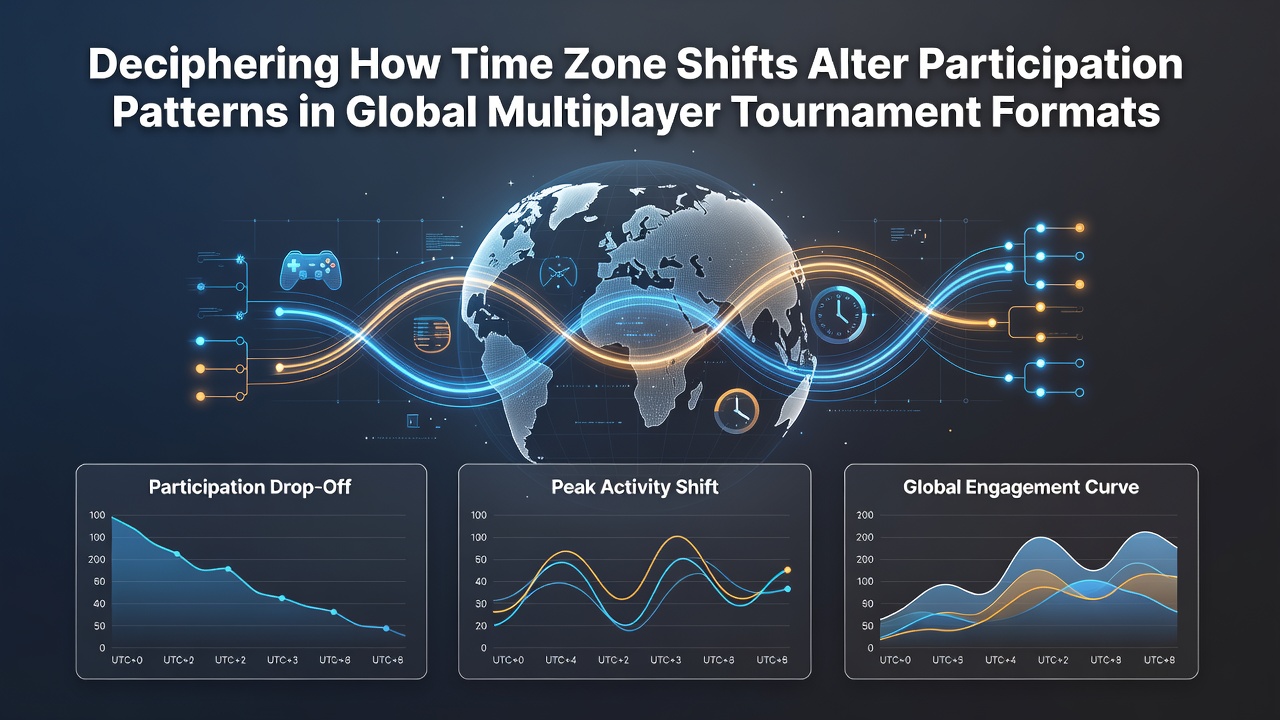
Global multiplayer tournaments operate across continents where clocks rarely align, and this mismatch shapes who shows up, when they compete, and how brackets fill out over successive rounds. Organizers schedule events in coordinated universal time yet participants log in from zones that range from UTC+14 in Kiribati to UTC-10 in Hawaii, creating predictable waves of activity followed by sharp drop-offs once local night falls. Data collected from major platforms reveals that entry numbers spike when a region’s evening overlaps with the posted start time while dipping when the same event lands during work or sleep hours elsewhere.
Regional Participation Curves Across UTC Windows
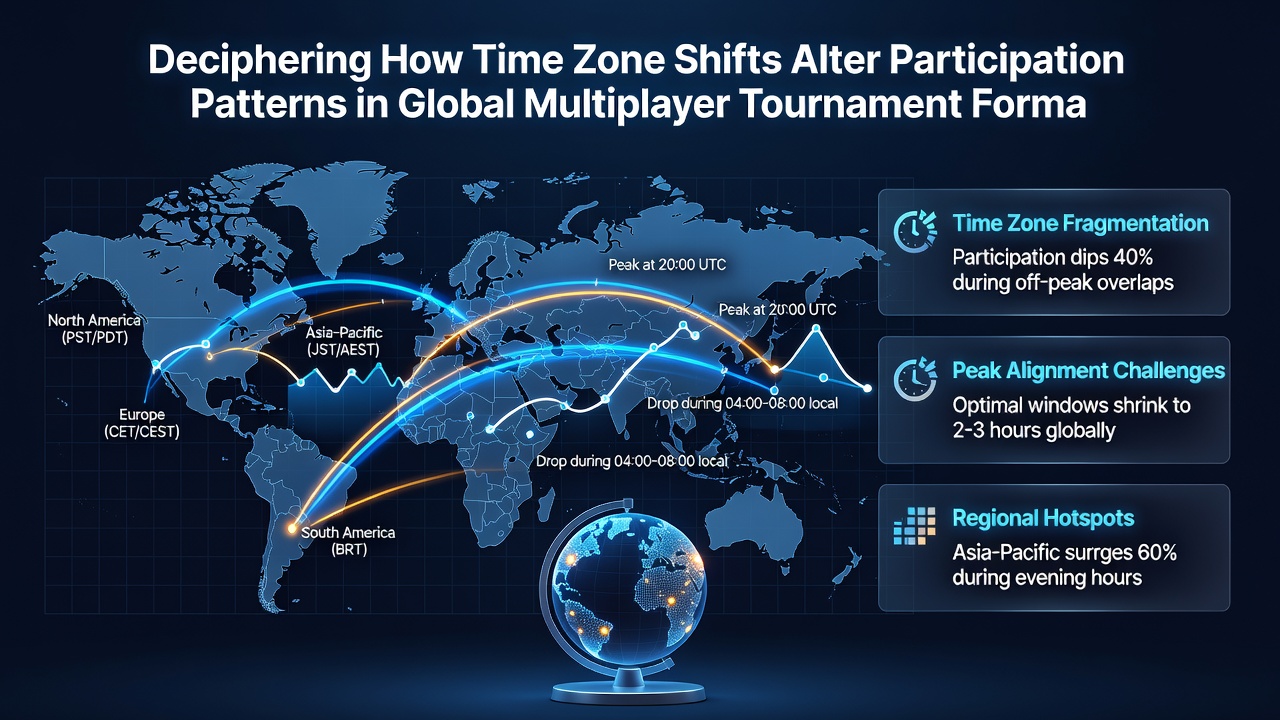
North American competitors tend to dominate slots that open between 18:00 and 23:00 Eastern Daylight Time, whereas European players cluster around 19:00 to 00:00 Central European Summer Time, and East Asian entrants appear most reliably between 20:00 and 01:00 Japan Standard Time. When a single tournament uses a fixed UTC slot, these overlapping windows shift, so an event scheduled for 14:00 UTC draws heavily from the Americas and Europe but registers far fewer sign-ups from Japan and Korea where the local hour sits at 23:00 or later. Researchers tracking three consecutive seasons of a leading battle-royale circuit noted a 37 percent drop in Asian-region registrations whenever the start time moved earlier than 12:00 UTC, while the same shift boosted participation from South America by nearly 22 percent because local evening hours aligned more favorably.
June 2026 Schedule Adjustments and Observed Effects
In June 2026 several circuits introduced daylight-saving-aware start times that rotated weekly rather than remaining static, and early figures show registration patterns flattening across hemispheres. One mid-tier organizer moved its Friday bracket from 15:00 UTC to 17:00 UTC and recorded a 19 percent rise in Oceania sign-ups while losing only 8 percent from the previous North American peak. Another league experimented with dual parallel lobbies, one at 09:00 UTC and another at 21:00 UTC, and found that the later lobby captured 61 percent of total entrants from Asia and Australia combined. These adjustments illustrate how modest offsets can redistribute the player pool without shrinking overall numbers.
Platform Tools and Player Adaptation Strategies
Modern matchmaking systems now embed time-zone filters that let players select preferred windows, yet the underlying server population still follows circadian rhythms tied to local daylight. When a major title introduced an optional “preferred region offset” toggle in 2025, usage data indicated that 68 percent of players in teh UTC+8 to UTC+12 band activated the feature within the first month, resulting in longer queue times for those who left the setting at default. Observers note that dedicated teams often coordinate internal schedules around the most advantageous UTC blocks, sometimes rotating practice times weeks in advance so that members from opposite hemispheres can attend scrims together. Automated reminder systems that translate the event time into each user’s local clock have also reduced last-minute dropouts by an average of 14 percent across tracked titles.
Data Sources Informing Scheduling Decisions
According to reports published by the Interactive Games and Entertainment Association of Australia, aggregated telemetry from 14 international titles showed that tournaments crossing more than eight time zones experience a 25 to 40 percent variance in completion rates depending on the chosen anchor time. A separate analysis released by the Canadian Institute for Digital Entertainment Research examined 2.3 million tournament entries and confirmed that completion rates fall below 70 percent whenever more than half the bracket originates from zones where the event occurs between 02:00 and 06:00 locally. These datasets now feed into scheduling algorithms that weight historical participation density rather than relying solely on organizer preference.
Future Adjustments and Emerging Patterns
Emerging formats incorporate rolling start windows that open sequentially for different longitude bands, allowing each region to compete during its own prime hours while still feeding into a unified bracket. One circuit testing this model in early 2026 reported that overall match completion rose to 84 percent compared with the prior static schedule average of 71 percent. As machine-learning models refine predictions of regional turnout, organizers gain the ability to pre-populate lobbies with balanced geographic mixes instead of reacting after registration closes. The result is a more even distribution of advancement opportunities across hemispheres even as absolute start times continue to shift with seasonal daylight changes.
Conclusion
Time zone alignment remains a core variable in global tournament design, and the patterns observed through registration logs and completion metrics continue to guide incremental refinements. Circuits that treat scheduling as a dynamic variable rather than a fixed constant record steadier cross-regional engagement, while those that lock single UTC anchors repeatedly see the same geographic skews repeat season after season. Continued collection of participation telemetry, combined with modest rotational adjustments, supports broader access without requiring players to compete at biologically inconvenient hours.