Cryptographic Protocols Enabling Secure Verification of Slot Payouts in International Networks
Written by Jakob Braun · Aug 18, 2026
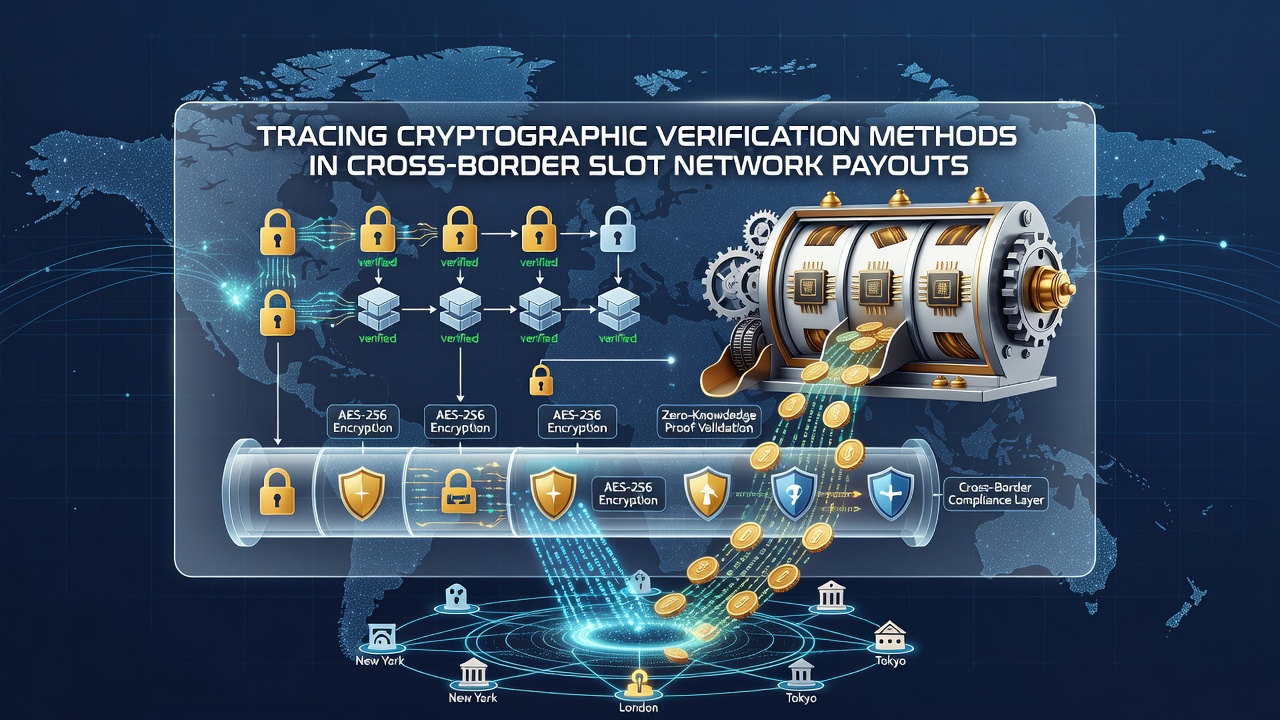
Cryptographic Protocols Enabling Secure Verification of Slot Payouts in International Networks
Slot networks that span multiple countries rely on cryptographic verification to confirm payout accuracy before funds move across borders, and researchers have documented specific tracing techniques that follow digital signatures from the initial bet through final settlement. These methods combine hash functions with timestamped transaction logs so that operators and regulators can reconstruct each step without exposing sensitive player data.
Digital signatures generated at the game server level attach to payout requests, and tracing tools examine the chain of signatures to detect any alterations during transmission. Observers note that elliptic curve cryptography appears frequently in these setups because it delivers strong security with smaller key sizes, which helps networks maintain speed while handling thousands of simultaneous transactions.
Core Tracing Techniques Used in Slot Networks
One established approach involves embedding unique nonces within each payout packet, and analysts trace these nonces backward through the network to match them against the original game outcome records. When a mismatch occurs, the system flags the transaction for manual review, and this process has become standard in several multi-jurisdictional platforms operating between North America and Europe.
Another method uses Merkle trees to organize batches of slot results, allowing verifiers to confirm an individual payout belongs to the correct batch without downloading the entire dataset. Data from industry reports indicates that this structure reduces verification time by up to 40 percent compared with linear ledger checks, and networks adopted it more widely after 2024 updates to international data exchange standards.
Cross-Border Data Flows and Verification Challenges
Regulatory requirements differ across regions, so cryptographic systems must accommodate varying rules on data retention and audit access. In August 2026, operators in the Asia-Pacific region began rolling out enhanced zero-knowledge proof modules that let auditors confirm payout integrity without transferring raw transaction details across borders. These modules build on earlier pilots conducted in Canada and Australia, where regulators tested similar protocols for compliance with privacy statutes.
Packet inspection tools monitor encrypted traffic for anomalies such as repeated nonce reuse or signature timestamp gaps, and experts at research institutions have published case studies showing how these anomalies sometimes signal routing errors rather than intentional tampering. When networks detect such issues, they trigger automated rerouting that preserves the cryptographic chain while complying with local latency rules.

Integration with Regulatory Reporting Systems
Many networks now feed verified payout logs directly into regulatory dashboards maintained by bodies such as the National Institute of Standards and Technology, which publishes guidelines on acceptable cryptographic primitives for financial-grade applications. NIST cryptographic standards serve as a reference point for operators seeking to align their tracing methods with recognized benchmarks. Separate frameworks from the European Commission’s digital finance initiatives further shape how signature chains must be stored for cross-border audits.
Case examples from networks connecting European and Latin American markets show that combining public-key infrastructure with distributed ledger entries creates an immutable trail regulators can query on demand. This combination has reduced dispute resolution times from weeks to days in documented instances, and similar setups now appear in platforms serving North American and Asian operators.
Future Developments in Verification Tracing
Quantum-resistant algorithms are entering testing phases for slot payout systems, and organizations such as the OECD have highlighted the need for forward-compatible tracing methods that remain functional once larger quantum computers become available. Early trials indicate that lattice-based signatures can replace current elliptic curve methods without disrupting existing nonce and Merkle tree structures.
Training programs for compliance teams now include modules on reading cryptographic audit trails, and several university research groups have released open datasets that simulate cross-border payout flows for educational purposes. These resources help new analysts practice identifying signature breaks or timestamp inconsistencies before they handle live network traffic.
Conclusion
Tracing cryptographic verification in cross-border slot networks continues to evolve through incremental upgrades to signature schemes, batch structures, and regulatory interfaces. Networks that maintain consistent nonce management and Merkle tree implementations demonstrate clearer audit paths, and ongoing work on quantum-resistant options suggests further refinements will arrive in coming years.